Advance knowledge
Develop theories, methods and evidence on responsible AI, recommender systems and computational user behaviour.
A broader view of impact
My work connects four forms of impact: advancing knowledge about how AI shapes human behaviour; building research groups and programmes that outlast individual projects; translating research into tools, field studies, organisational learning and policy input; and mentoring researchers who bring this expertise into academia, industry and public service.
Four dimensions
Research impact is strongest when evidence, institutions, people and practice reinforce one another.
Develop theories, methods and evidence on responsible AI, recommender systems and computational user behaviour.
Create research groups, programmes, funding portfolios and partnerships that make sustained work possible.
Move questions and prototypes into field studies, newsroom workflows, decision support, partner learning and policy discussions.
Mentor students and researchers and create pathways into academic, public-sector and industry roles.
Research influence
The publication record spans foundational recommender-systems research and applied work in media, health and food.
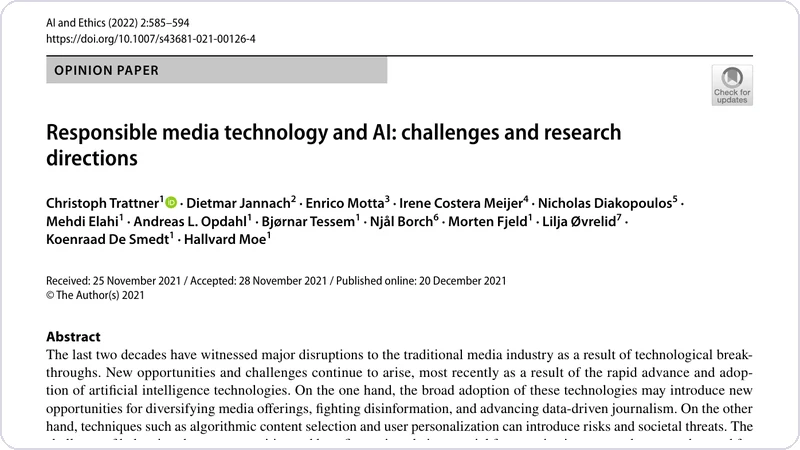
Research on professional ethics, provenance, usable transparency and human oversight has helped define responsible media AI as a field of study and practice.
Explore the research →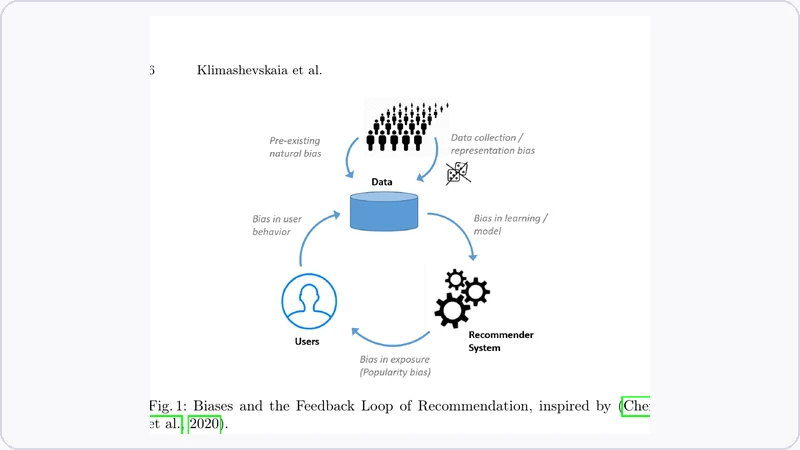
Work on similarity, popularity bias, explanation and long-term user effects advances recommender systems that account for agency, diversity and societal consequences.
See the research initiative →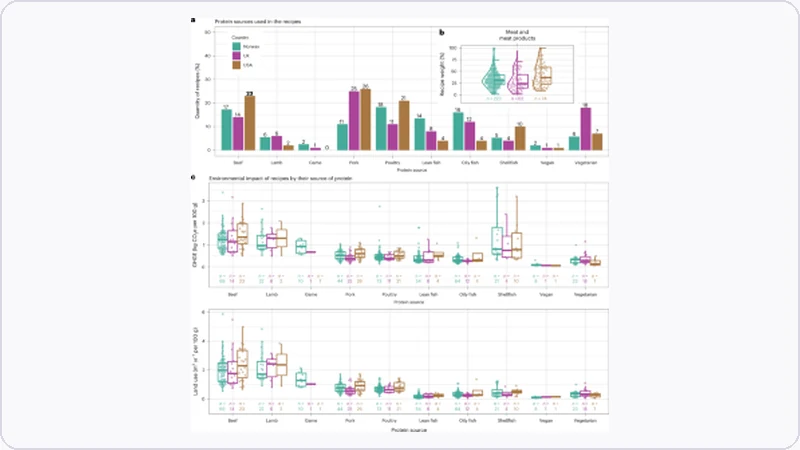
Cross-country recipe analyses, behavioural studies and AI-tailored advice connect computational methods with nutrition, sustainability and decision support.
View related publications →Institution building
Some of the most durable impact comes from building teams, programmes and infrastructure rather than from any single paper or prototype.
I founded and lead a research group focused on recommender systems, connecting methodological depth with applications in media, health and food.
Visit DARS →An interdisciplinary collaboration environment linking behavioural theory, computational modelling, human-centred AI and partner-based evaluation.
Explore the initiative →A portfolio spanning MediaFutures, NEWSREC, RE-AIMED, CuratedAI, VaccAI, NutriCal65 and international collaborations creates continuity across questions, people and domains.
See selected funding →Direct research-to-practice cases
Selected cases connecting my own research involvement with MediaFutures, empirical studies, prototypes and partner-relevant evidence.
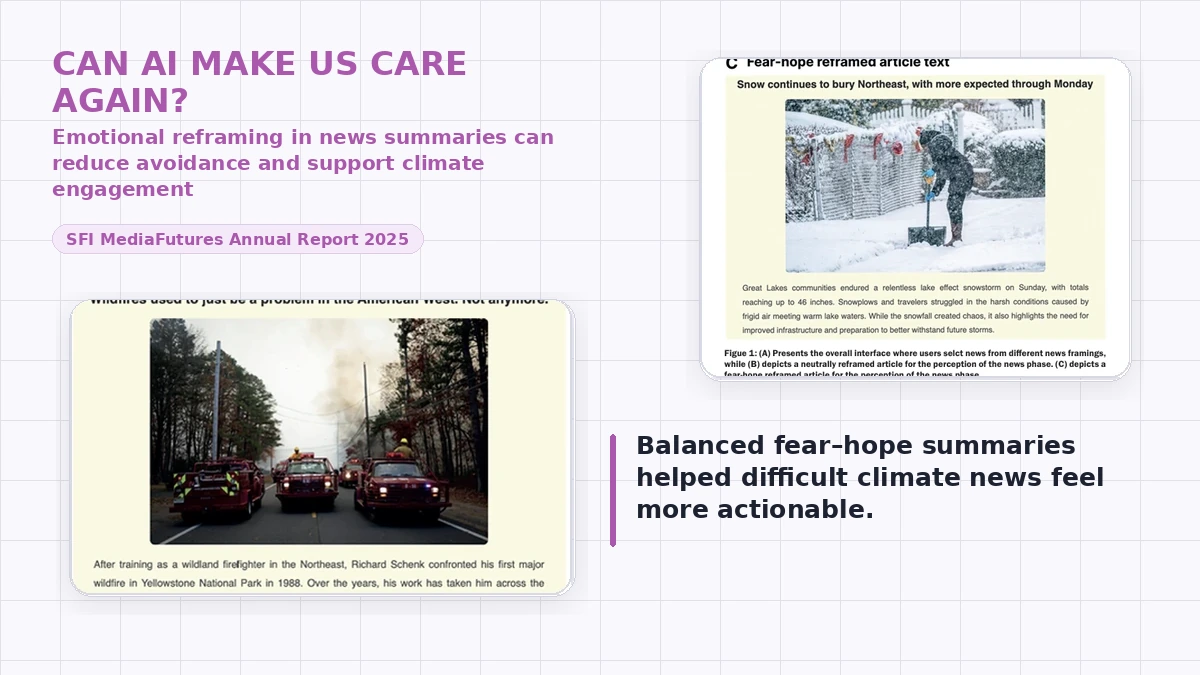
MediaFutures research tested whether GPT-generated emotional framing can make difficult climate-related news summaries less avoidable and more motivating. The work shows how responsible AI can support engagement without relying on simplistic clickbait or polarising emotional cues.
My role: Principal investigator of the study, co-author and senior researcher, contributing to the research agenda connecting LLM-generated summaries, news avoidance, recommender systems and pro-social engagement.
Related paper →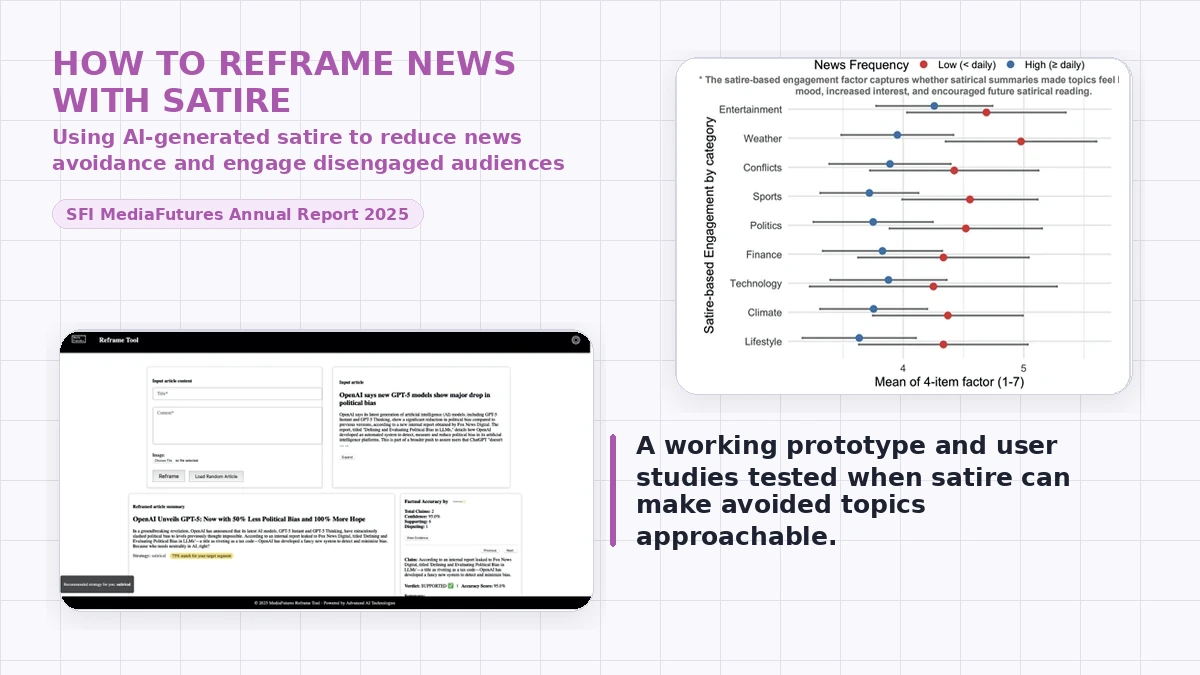
A MediaFutures study examined whether LLM-generated satirical summaries can make serious news topics more approachable while preserving perceived quality and informational value. The case demonstrates how recommender-system research can explore engagement beyond more-of-the-same personalisation.
My role: Principal investigator of the study, co-author and research supervisor, helping frame the work around news avoidance, responsible recommendation and human-centred evaluation.
Related paper →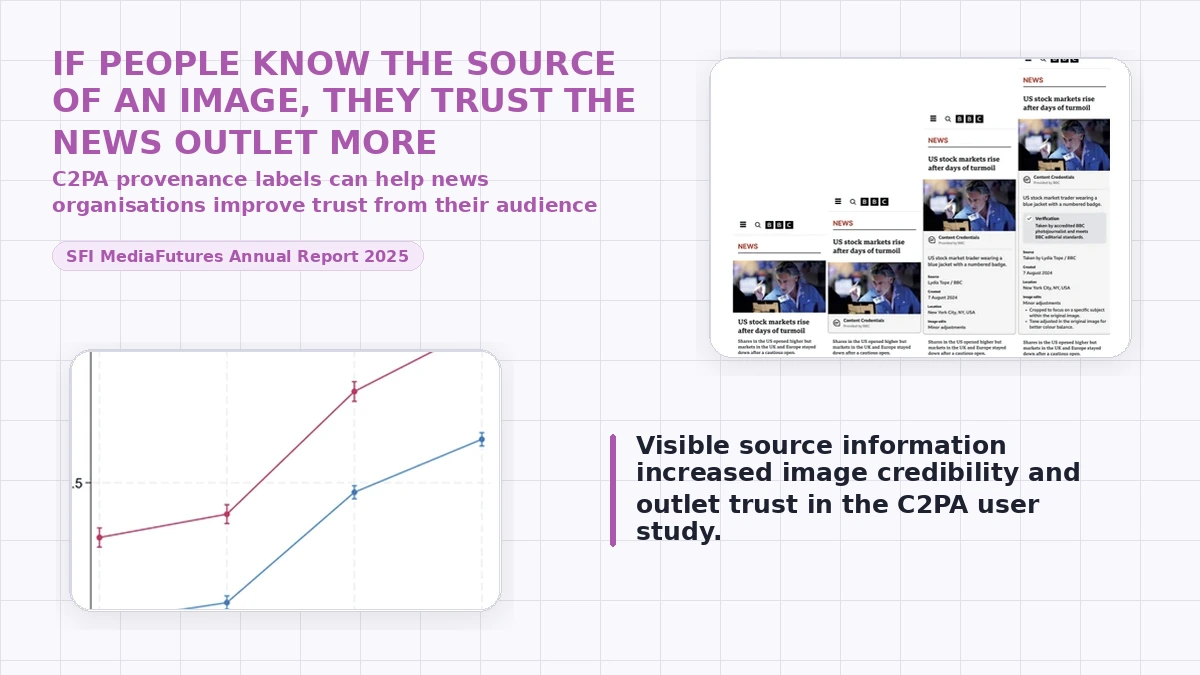
A three-country study translated a technical authenticity standard into evidence about image credibility, source transparency and trust in news outlets. The case connects content provenance with concrete user evidence for newsroom and media-cluster innovation.
My role: Principal investigator of the user study, centre director and strategic link to the wider media-cluster initiative.
Related paper →Selected partner outcomes
The cases below are selected collective outcomes from SFI MediaFutures. They show how a long-term research environment can connect evidence with editorial and production settings.
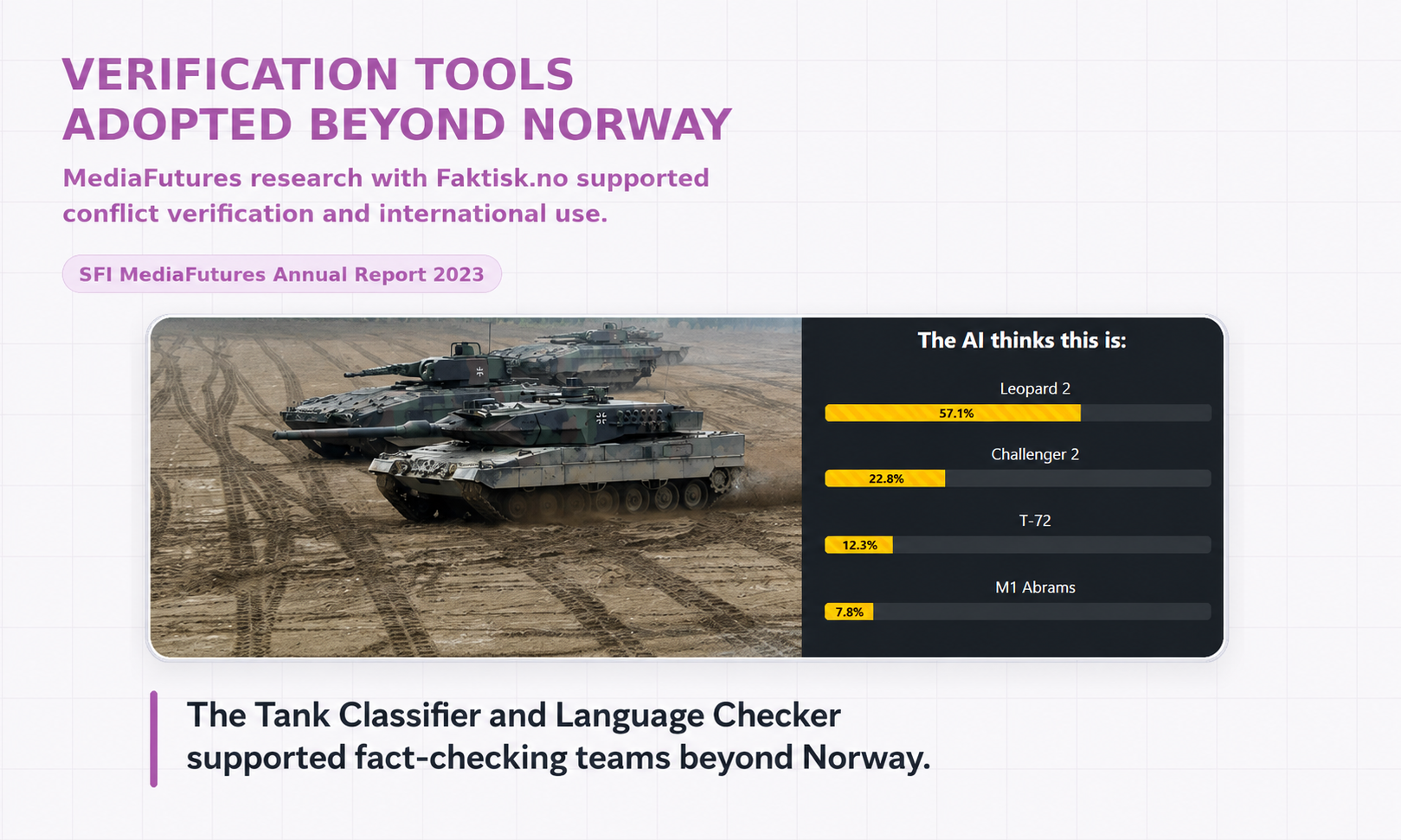
Verification technology developed in the centre, including the Tank Classifier and Language Checker, supported work at Faktisk.no and AFP.
My role: Centre-level strategy, partnership environment and research translation; tool development was led by the credited WP3 researchers and Faktisk.no collaborators.
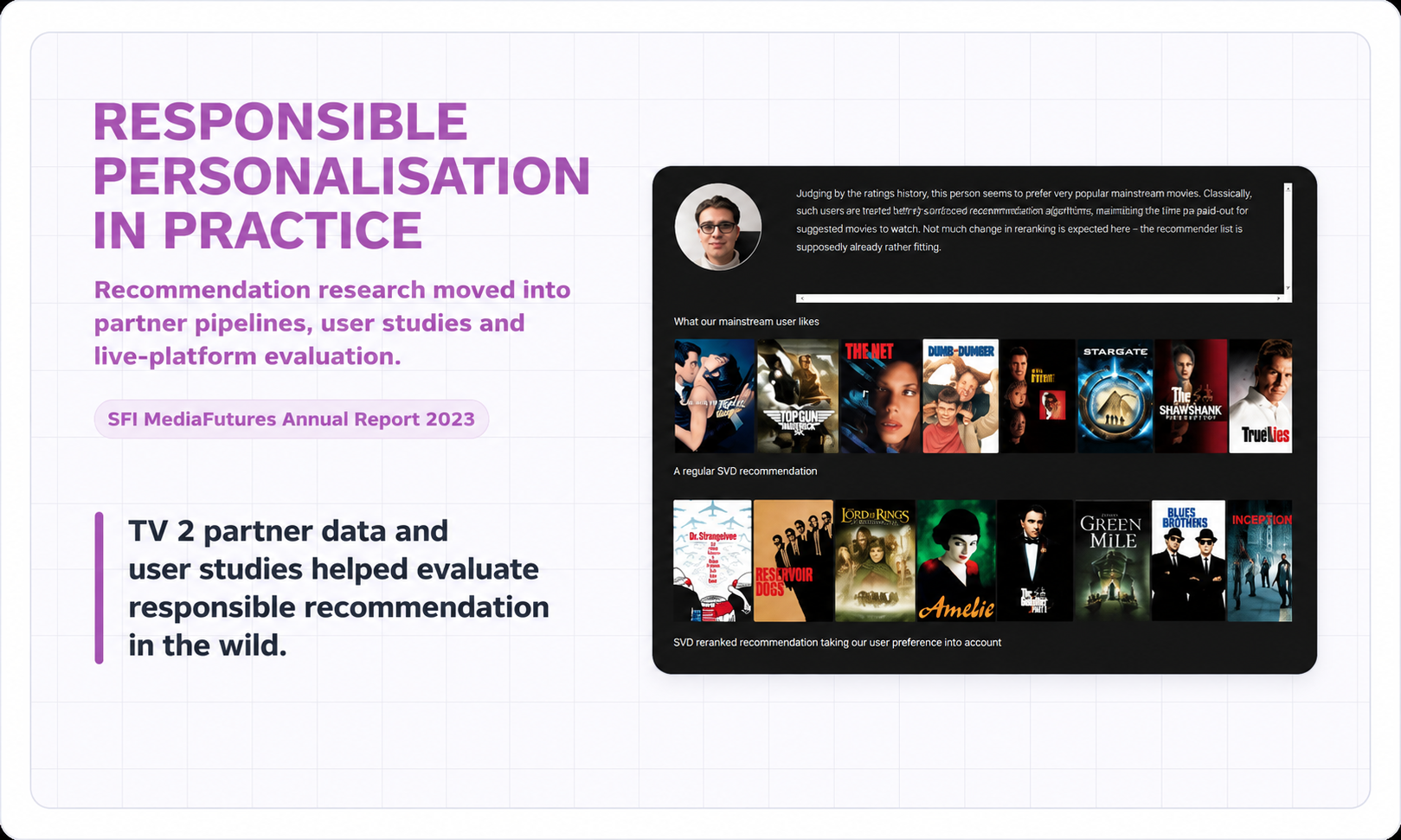
Research on recommendation moved from modelling and prototypes into TV 2 pipelines, user studies and live-platform evaluation.
My role: Scientific contribution to responsible recommendation, centre leadership and development of the long-term TV 2 partnership.
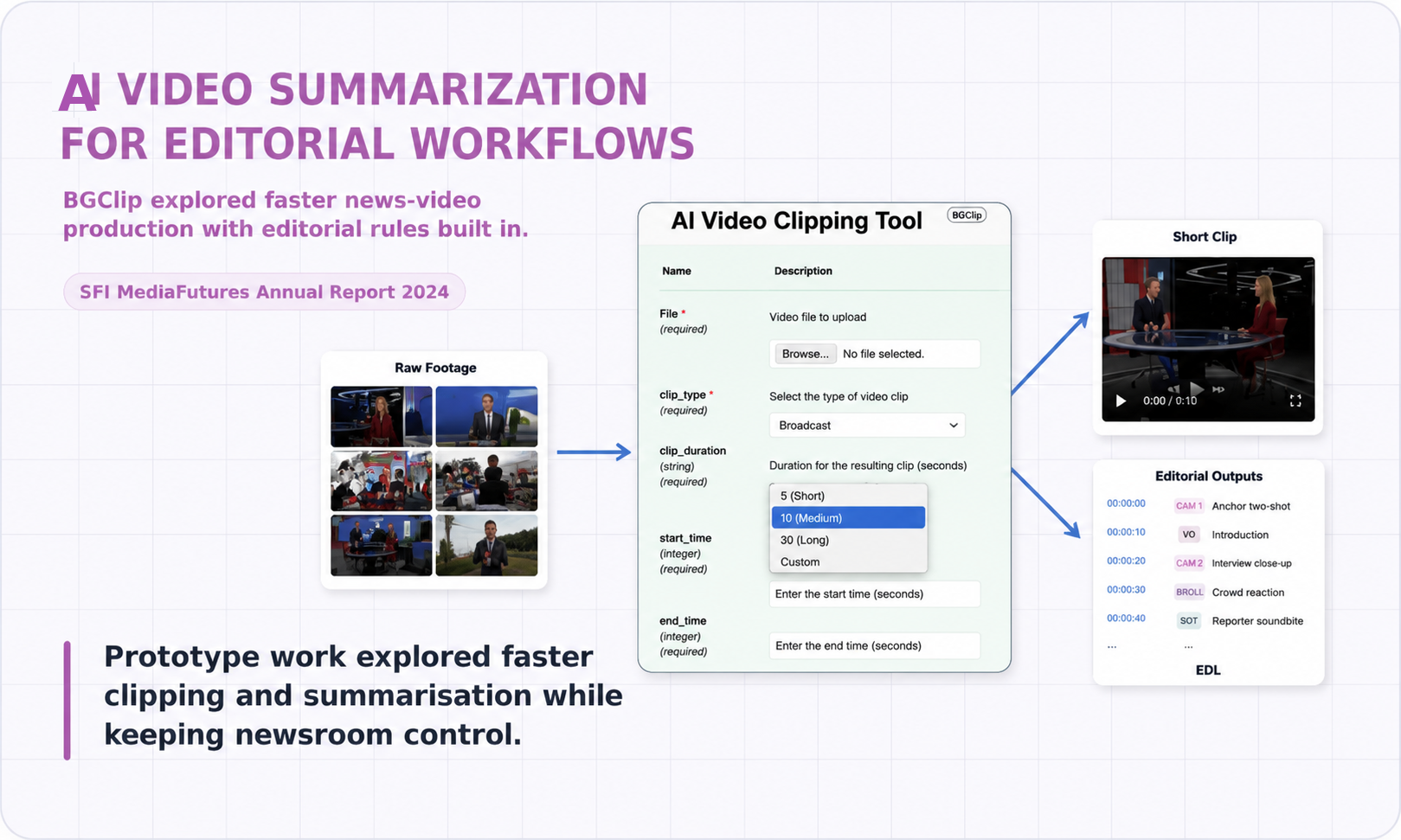
BGClip explored faster news-video production with editorial rules built in, while AiModerator investigated contextual support during political debates.
Attribution: BGClip was led by WP3. Context and fact support during political debates was led by WP4. My role was centre-level strategy, funding and partner-facing research infrastructure.
Food, health & public understanding
A continuing research programme on how digital food information relates to health, sustainability and choice.
My role: First author of the 2017 study and 2019 commentary; co-author of the 2023 study. Each contribution reflects the work of the credited research team. See coverage and bylines →
People and professional influence
Training, supervision, evaluation and public engagement extend the value of research well beyond individual projects.
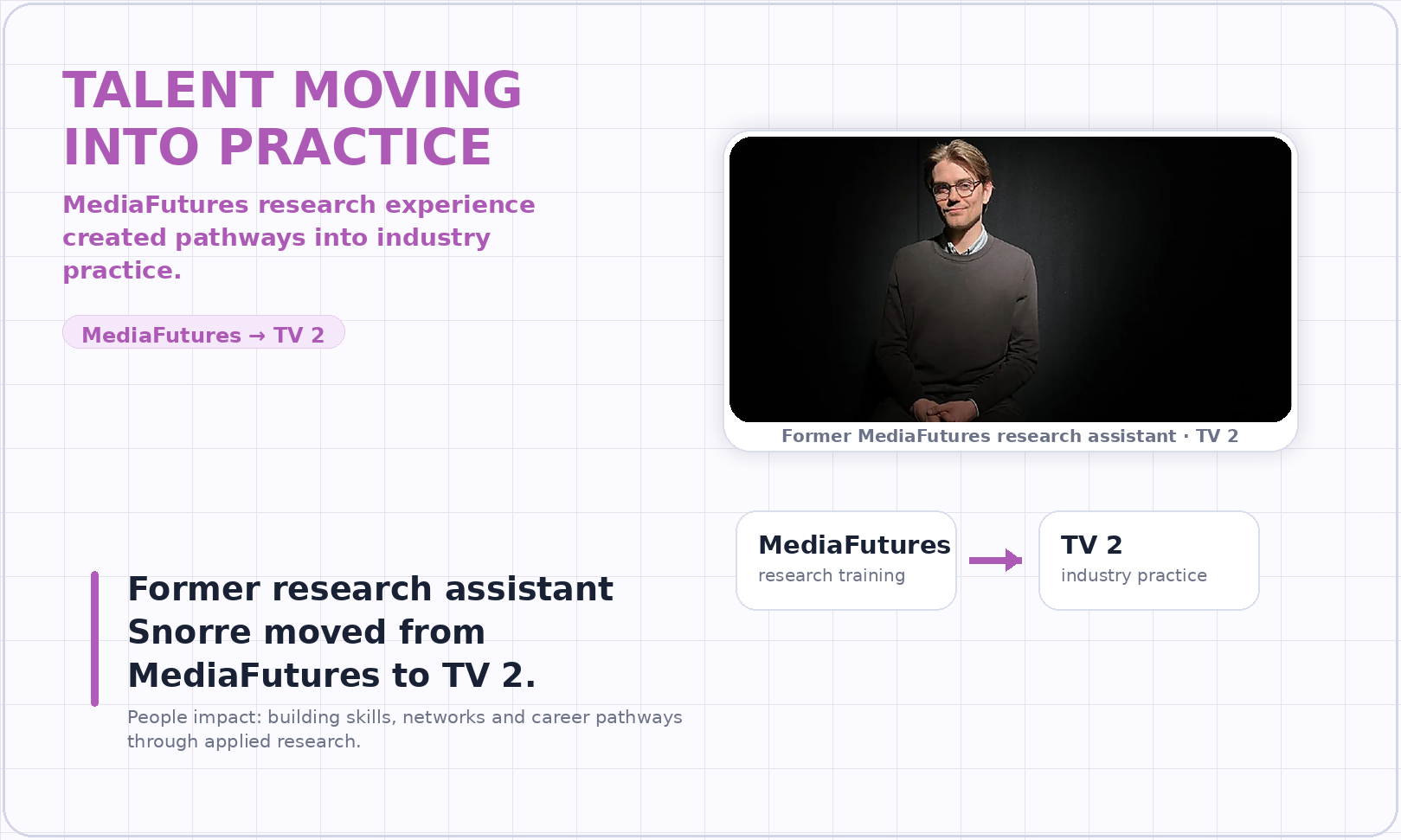
Former research assistant Snorre Alvsvåg moved from MediaFutures into TV 2, illustrating how centre-based research experience can create pathways from applied AI research into industry practice.
Supervision and co-supervision of 35+ Master’s students and 10+ PhD researchers across Norway, Austria, Germany and international partner institutions, with an emphasis on intellectual independence, rigorous study design and publishable contribution.
Independent expert review for the Research Council of Norway, EPSRC, FWO and NWO; senior programme-committee service at ACM SIGIR and ACM RecSys; manuscript review or editorial work for Nature Portfolio journals and UMUAI; and public engagement, including an invitation from the Norwegian government to participate in the UN Internet Governance Forum in 2025.
Leadership and service
Selected roles showing how the work extends into conference leadership, institutional governance, editorial responsibility and independent evaluation.
Workshop and Late-Breaking Results Co-Chair at ACM RecSys (2018–2020) and Senior Programme Committee member at ACM SIGIR (2020–2021).
Co-organised 14 international workshops, including co-founding HealthRecSys, and served on programme or senior programme committees at 52 international conferences.
Former Board Member of Media City Bergen (2021–June 2022), earlier university senate and data-science steering-board service, and invited by the Norwegian government to participate in the UN Internet Governance Forum in 2025.
Reviewed grant proposals for EPSRC, FWO and NWO; served as UMUAI Special Issue Editor and on editorial boards across AI, data and information-science journals.
My contribution
The recurring pattern is to connect a strong research question with the people, resources and settings needed to test it properly.
Identify consequential questions around AI, behaviour, trust, health and democracy.
Assemble teams, partners, governance and funding around a coherent programme.
Combine computational methods, prototypes and human-centred empirical evaluation.
Connect findings to partner learning, new projects, talent development and institutional capacity.
Public engagement
Selected opinion pieces, interviews and responses on AI, journalism, learning and research policy. Authored commentary is kept distinct from independent coverage.
Work with me
I work with academic, public-sector and industry partners on responsible AI, recommender systems and computational user behaviour.
Documentation note. Claims in the MediaFutures direct research-to-practice and partner cases are based on peer-reviewed papers, project outputs and SFI MediaFutures Annual Reports 2020–2025. The framed visuals are excerpts from those papers, prototypes or reports. MediaFutures outputs remain collective achievements of the researchers and partner organisations credited in the underlying work.